


How Many Custom T Shirts Should You Order? A Brooklyn Guide to 12, 24, 50, 100+
- BKNY PRINTING
- Aug 14
- 9 min read
BKNY PRINTING — FREE GAME
“How many T-shirts should I order?”
That is one of the most common questions in custom apparel printing, and the honest answer is that there is no one perfect number. A family reunion does not need the same order plan as a restaurant staff uniform run. A clothing brand testing a new design should think differently than a nonprofit preparing for a large fundraiser.
The right quantity depends on a few real-world factors:
What the shirts are for
How many people need one
Your budget
The printing method
The size breakdown
Whether the shirts are being sold or given away
Whether you expect to reorder later
At BKNY Printing in Bushwick, Brooklyn, we help customers make smarter decisions before production starts. Good planning can save money, avoid leftover boxes of shirts, and prevent that stressful moment when someone asks, “Do you have one in my size?”
If you are searching for custom T-shirt printing Brooklyn, T-shirt printing Brooklyn, or custom shirts near me, this guide will help you think through the numbers before you place an order.

Start With the Purpose of the Shirts
Before you ask, “how many T-shirts should I order,” ask what the shirts need to do.
A 12-shirt order might make sense for a staff, crew, or small team. A 24-shirt order may be better for a pop-up, birthday trip, or small event. If you are selling shirts, 50 to 100 pieces often gives you more room to cover sizes, test demand, and avoid selling out too early.
Here is a simple way to think about purpose.
Use case | Common order range | Why it works |
Small staff, team, or crew | 12 to 24 shirts | Enough for the core group, with a few extras |
Family events or celebrations | 12 to 50 shirts | Depends on RSVPs and size mix |
Restaurants and hospitality | 24 to 100 shirts | Staff may need multiple shirts each |
Schools, churches, and nonprofits | 50 to 200+ shirts | Larger groups and events need backups |
Clothing brand test drop | 24 to 100 shirts | Lets you test demand without sitting on too much stock |
Fundraisers and public events | 50 to 300+ shirts | Sales, giveaways, volunteers, and sponsors add up |
Corporate or company apparel | 50 to 500+ shirts | Multiple departments, sizes, and repeat needs |
The purpose also affects how careful you need to be with sizes. A staff order is usually easier because you can collect exact sizes. An event order needs more flexibility because people may show up without preordering.
What 12 Shirts Usually Means
A 12-shirt order is best for small groups with a clear list of people.
This might include:
A small business team
A restaurant opening crew
A bachelor or bachelorette trip
A creative crew
A church committee
A small run of merch for friends and family
For many customers, 12 is the first number that feels “real.” It is enough to outfit a group, but it is still small enough to manage closely.
The main benefit is control. You can collect everyone’s size, choose a simple design, and avoid extra inventory. The tradeoff is that the cost per shirt is usually higher than larger quantities. That is because printing involves setup, artwork preparation, garment sourcing, and production time.
If you are looking for small batch T-shirt printing, 12 shirts can be a good starting point. Just know that not every printing method works the same at this size. Some designs are better suited for direct-to-garment, DTF transfers, or vinyl. Screen printing can be possible for small orders, but it may not always be the most cost-effective choice.
Small orders are great for exact needs. Larger orders are better when you want a lower cost per shirt or plan to sell, replace, or restock.
What 24 Shirts Usually Means
A 24-shirt order gives you more breathing room.
This quantity works well when you need shirts for a defined group but also want a few extras. It is common for:
New businesses ordering staff shirts
Restaurants buying multiple shirts per employee
Pop-up shops
Community events
School clubs
Small merch drops
Local teams
If you have 18 people, ordering exactly 18 shirts can feel efficient, but it leaves no room for size swaps, new staff, last-minute guests, or washing cycles. Ordering 24 gives you a small cushion without turning the project into a bulk order.
For custom shirts for businesses, 24 can also be a smart first run. A new café, barbershop, gym, or creative studio may not know yet which garment style employees will like or how the shirts will hold up during daily use. A 24-piece order lets the team wear-test the shirts before committing to a bigger run.
If you are comparing custom apparel printing Brooklyn options, ask how the shop handles small and mid-size runs. A good print partner should explain what makes sense for your design, not push you into a higher number just because.

What 50 Shirts Usually Means
A 50-shirt order is often the sweet spot for events, teams, and small merch releases.
At this quantity, you have enough pieces to cover a wider size range. You also have more flexibility for sales, giveaways, volunteers, sponsors, and last-minute needs.
A 50-shirt order is common for:
Fundraisers
School events
Fitness challenges
Church groups
Community organizations
Local music releases
Artist merch
Restaurant staff and customer merch
Startup launch events
This is also where the math starts to feel different. The setup work gets spread over more shirts, so the cost per piece often becomes more attractive than a 12-shirt or 24-shirt run. That does not mean every 50-shirt order is “cheap,” since garment choice, print locations, ink colors, and finishing all matter. It does mean the order starts to feel more efficient.
For custom shirts for events, 50 pieces can be enough if the guest list is controlled. If the event is open to the public, 50 may be a starting point rather than the full need.
Here is a simple example. If you expect 75 attendees and only volunteers need shirts, 50 may be more than enough. If you expect to sell shirts at the event, 50 could sell out quickly if the design is strong and the price is right.
What 100 or More Shirts Usually Means
When you order 100+ shirts, you are usually planning beyond one small group.
This is where bulk custom T-shirts make sense for:
Larger events
School-wide orders
Company apparel
Nonprofit campaigns
Church conferences
Restaurant groups
Brand merch drops
Tour merch
Walks, races, and awareness campaigns
Multi-location teams
For bulk T-shirt printing NYC, planning matters more because mistakes scale. If your size breakdown is off on 12 shirts, the issue is small. If it is off on 300 shirts, you may end up with boxes of sizes nobody asked for.
The upside is that larger orders often lower the per-shirt cost, especially for screen printing. Brooklyn screen printing is a strong fit for many 100+ shirt orders because the setup makes more sense when the same design is printed many times.
Bigger orders also leave room for future use. If staff will keep wearing the shirts, if new members may join, or if you plan to sell over several weeks, ordering extra can be smart.
Match the Quantity to the Printing Method
The best quantity is connected to how the shirts will be printed.
Screen printing works well for repeat designs
Screen printing is a classic choice for clean, durable prints, especially when the same artwork goes on many shirts. It is often a strong fit for 50, 100, or more pieces.
The cost includes setup, so very small runs can feel expensive compared with other methods. As the quantity grows, screen printing often becomes more efficient.
Use screen printing when:
You have a bold design
The same artwork goes on every shirt
You need strong ink coverage
You are ordering in bulk
You want a proven shop-style print feel
Digital and transfer methods can help smaller runs
For lower quantities, full-color artwork, or quick tests, digital and transfer-based printing can make more sense. These methods can work well when you do not want to commit to a large run.
They are useful for:
Small batch T-shirt printing
Artwork with many colors
Sample drops
Personal events
One-off size needs
Testing a design before going bigger
The best method depends on the artwork, garment, timeline, and budget. A good NYC T-shirt printing team should help you compare options instead of giving a one-size answer.
Build a Smarter Size Breakdown
Quantity is only half the order. Sizes are where many custom shirt projects go wrong.
If you know everyone getting a shirt, collect sizes first. Do not guess. A simple form can save a lot of trouble.
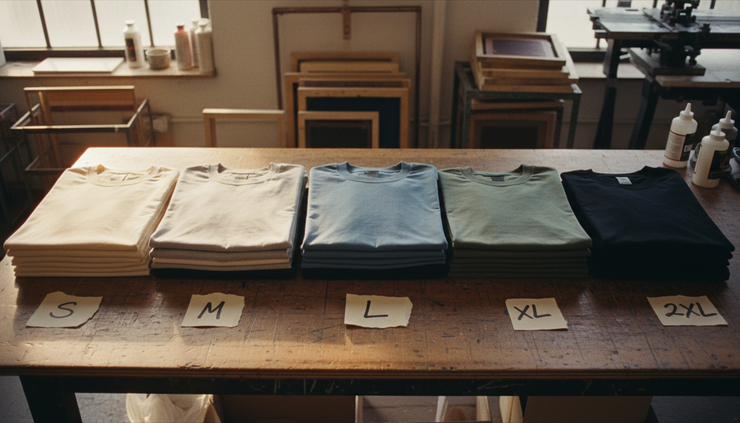
If you are ordering for an open event or selling merch, you need a balanced size spread. Every audience is different, but many general adult T-shirt orders lean heavily toward medium, large, and extra large, with smaller amounts of small, 2XL, and 3XL.
A sample 50-shirt breakdown might look like this:
Size | Sample quantity |
Small | 5 |
Medium | 12 |
Large | 16 |
XL | 12 |
2XL | 4 |
3XL | 1 |
This is only a starting point. If your group has known sizes, use real numbers. If your audience is fashion-focused, younger, older, athletic, hospitality-based, or community-based, the size mix may shift.
For clothing brands, sizing is even more important. A brand selling oversized streetwear may need more XL and 2XL than a school staff order. A fitted women’s cut, youth shirt, hoodie, or heavyweight tee changes the plan again.
Decide Whether You Are Giving Shirts Away or Selling Them
Free shirts and sale shirts require different planning.
If the shirts are giveaways, the goal is usually coverage. You want enough shirts for the right people without wasting the budget. Extras are useful, but too many leftovers can become storage clutter.
If the shirts are for sale, the goal is inventory balance. You want enough to meet demand, but not so many that your cash is tied up in unsold shirts.
For a first merch drop, many artists and creators start with 24 to 50 pieces. That gives them a real product to sell without taking on too much risk. If demand is proven, the next order can move to 100 or more.
For established groups with an existing audience, preorders help. If 83 people already paid or signed up, then a 100-shirt order may be safer than 75. The extra shirts can cover size exchanges, late buyers, or display samples.
This is where the question “how many custom shirts should I order” becomes a business decision, not just a printing decision.
Know Your Minimum T-Shirt Order Before You Plan
Every shop has its own minimum T-shirt order rules, and the minimum may change based on the print method, number of colors, garment type, and deadline.
For example, a shop may accept smaller quantities for one method and require more for another. A complex multi-location print may also need a higher starting quantity than a simple one-color front print.
Before you build your budget, ask:
What is the minimum for this print method?
Does the minimum change with more ink colors?
Can sizes be mixed within the order?
Can shirt colors be mixed?
What happens if I need a reorder later?
Is the same setup saved for future runs?
A clear answer up front helps avoid surprises. If a project starts at 12 pieces but the method makes more sense at 24, you can make that decision early.
Plan for Reorders and Future Needs
A lot of customers only think about the first order. Smart buyers think one step ahead.
If you are ordering staff uniforms, ask how often new workers join. If you are organizing an annual event, think about whether the design will be used again. If you are launching merch, ask whether a restock is likely.
Reorders can be easier when the artwork, garment style, ink colors, and placement are documented. Keep those details together. If you switch shirt brands or colors later, the final result may not match perfectly.
For businesses and organizations, ordering a little extra often makes sense. For a one-time private event, exact ordering may be better.
A few extra shirts can help with:
New employees
Damaged or lost shirts
Size exchanges
Display samples
Volunteer add-ons
Last-minute guests
Future giveaways
Too many extras can waste money. Too few can create stress. Aim for a cushion that matches the project.

A Simple Quantity Guide for Common Orders
Use this as a planning guide, not a rulebook.
If this sounds like your project | Start around |
Small group with exact sizes | 12 |
Staff order with a few extras | 24 |
Small event or first merch test | 24 to 50 |
Fundraiser, pop-up, or team order | 50 |
Larger public event or organization | 100+ |
Company-wide, school-wide, or campaign order | 200+ |
If the shirts are mission-critical, order early and build in extras. If the shirts are experimental, start smaller and learn from the first run.
For custom T-shirt printing NYC, the best suppliers should help you understand these tradeoffs. The goal is not always to order the most shirts. The goal is to order the right shirts.
The BKNY Printing Takeaway
So, how many T-shirts should you order?
Order 12 when the group is small and sizes are known.
Order 24 when you need a real run with a little room for extras.
Order 50 when you are planning an event, testing merch, or covering a wider size range.
Order 100+ when you need better bulk efficiency, larger coverage, or inventory for sales and future use.
The best number depends on purpose, budget, printing method, size breakdown, and whether you may need more later. If you are looking for custom apparel printing Brooklyn, custom T-shirt printing NYC, or reliable bulk custom T-shirts from a shop that understands real orders, BKNY Printing can help you think it through before anything goes to press.
A smart order does not start with a random number. It starts with a clear plan.


Comments